
There is no real European Big Tech, but there are smaller companies with decent solutions that have a lot of potential as alternatives to Big Tech. As European consumers, we need to start using them, so we can give them the chance to grow and become fully fledged alternatives to US and Chinese Big Tech. In order to understand what digital consumer services exist and which ones are important, a three tiered Digital Consumer Services framework has been created. Europe should focus first on the tier 1 services to break free from Big Tech. In addition, some interesting European solutions are proposed for the tier 1 (most important) digital services.
Introduction
In previous articles, we analyzed why there is no European Big Tech, which was particularly due to fragmented markets, risk-averse finance and complex regulation. We also discussed why it is important to have European tech, which was linked primarily to two compelling events. First of all, countries are becoming more and more focused on themselves (especially the US). Secondly, Big Tech is mingling in politics as well as the other way around. Access to Big Tech is becoming a geo-political bargaining chip and Europe is not at all in a good position. The EU and national governments have an important role to play in order to stimulate the growth of European solutions. However, as European consumers we also should start using European solutions. On eurotechguide.com, European alternatives to US and Chinese Big Tech will be explored in order to help consumers choose European digital services.
Digital Consumer Services framework
Before diving head first into European alternatives, it is important to first establish what services we are talking about. In order to clarify this, I created the following Digital Consumer Services framework in which three tiers of digital services for consumers are distinguished:
- Tier 1: fundamental services that we need frequently in our daily life (like “Search” and “Messaging”) and/or are part of critical infrastructure (like “Finance”). If these are not available, they have a deeply negative effect on the productivity, can impact well-being and may even impact the livelihood of a user.
- Tier 2: enabling services, which are important and boost productivity, but if they aren’t available it’s inconvenient not disastrous. For some services, like “Maps” and “Chatbot (GPT)”. However, it does depend on the user if they should be categorized as tier 1 or tier 2. For example, for delivery services, “Maps” is without doubt tier 1.
- Tier 3: entertainment services, which are great if they work, but have little productivity impact if they don’t. One could even argue that having no social media cloud lead to increased productivity for many people. Anyway, I hope you get the gist of it. Also here it depends on the user – for social media influencers “Social Media” is obviously tier 1, not tier 3.
Below you find an overview of the Digital Consumer Services framework, including the division in tiers.
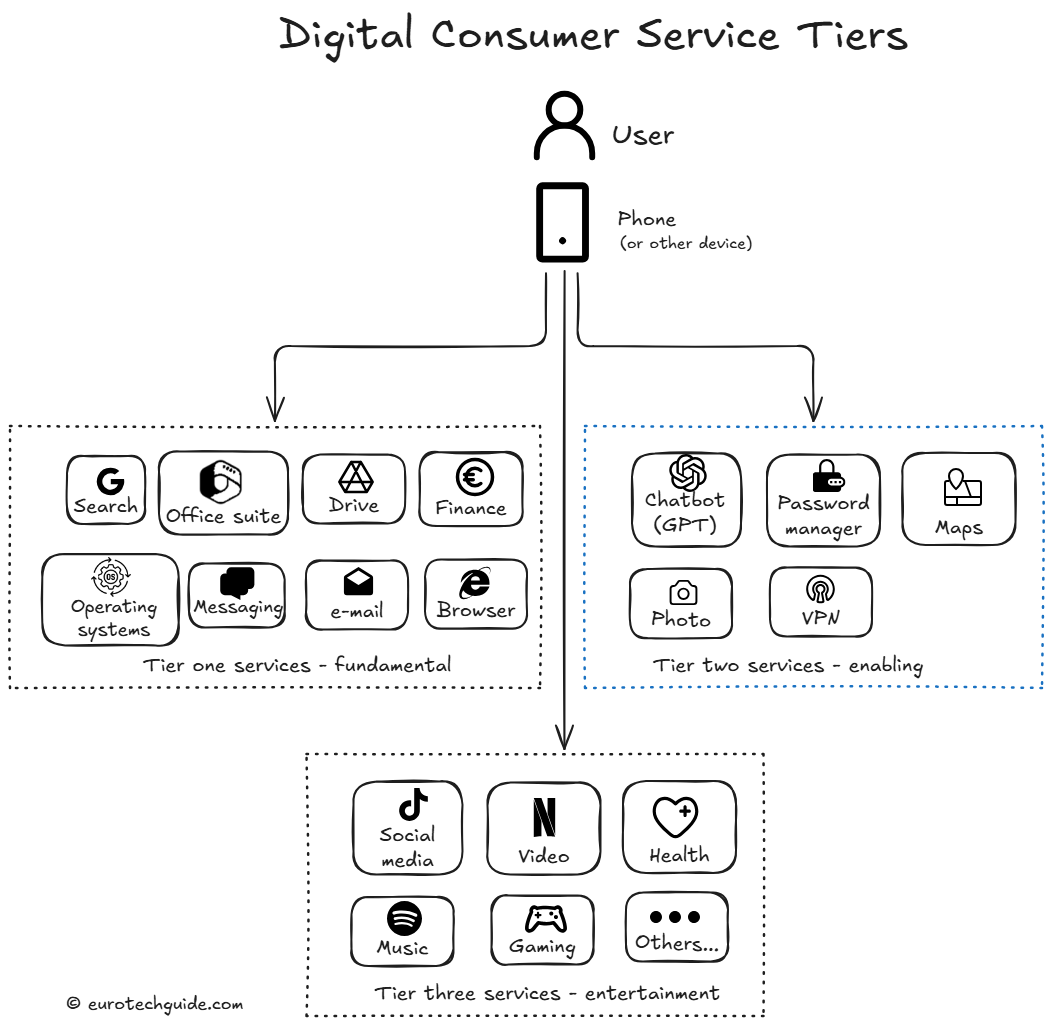
The categorization into tiers is based on the expected usage of average consumer – as I stated before, this may differ per person.
Current state of tier 1 Digital Consumer Services in Europe
eurotechguide.com is about what choices European consumers can make to stimulate the growth of European digital services without significant compromises. Europe should focus on tier 1 first, so let’s start with tier 1 and have a first look at decent European alternatives. I filtered only solutions which have an annual revenue exceding 15M Euro in a recent year. Most of these are still small companies and there is a higher risk of being bought (by e.g. American Big Tech) or going bankrupt, but these have a least some size and a decent reputation. Below, an overview can be found of what companies qualify for this, including a size estimate (revenue/market share):
| Service category | Name | Logo | Comment |
| Search | ecosia |  | ~€2.97M revenue/month (~€36M/year), 0.11% global market share |
| Search | Qwant |  | ~$19M/year revenue 0.06% global market share |
| Office suite | Infomaniak |  | $43.9/year revenue |
| Drive | Proton & Infomaniak |  | Proton: $124M revenue/year |
| Finance | Scattered solutions: Klarna, Adyen, Nexi, bank apps, others | No clear PayPal competitor, but various scattered solutions, which will be explored at a later stage. In general, this category is not strongly dominated by Big Tech, but more by banks and scattered solutions. | |
| Operating Systems | Desktop: Suse Mobile: too small |  | Suse revenue/year: $700M/year There are some small European mobile OS, like Sailfish, but <€20M/year |
| Messaging | Wire Threema |  | Wire: $29.7M revenue/year Note: Threema disqualifies with about $5 million/year revenue. |
| Proton & Infomaniak | | See previous rows | |
| Browser | Ecosia | | See first row. |
In the figure below, these companies are plotted on tier 1 of the Digital Consumer Services framework, as well as their Big Tech equivalents:

Each digital service category (except “Finance”) is heavily dominated by American Big Tech and there are zero European alternatives that are known to the average consumer. However, there are promising European alternatives as shown in this paragraph.
So what can you do already?
In later articles I intend to dive deeper into each of those service categories and I will review some of these solutions extensively. If you want to read more, there are already some other articles which provide additional information and more alternatives, but none of these provide real evaluations nor reviews of the proposed options:
- Wire.com – “The Ultimate Guide to European Alternatives to Big Tech Tools”: provides some more options for some of the digital service categories.
- Dev.to – “Top 20 European Alternatives to Major US Technology Services: You Could Change Right Now”: provides options for some of the digital service categories, but tier 1, 2, 3 and enterprise services categories (like web hosting) are mixed.
- https://european-alternatives.eu: extensive directory of European alternatives, but more aimed at digital enterprise services
Conclusion
In this article, a Digital Consumer Services framework has been introduced in which 3 tiers are distinguished in which services are categorized. The most important and frequently used in tier 1 (foundational), secondary ones in tier 2 (enabling) and tier 3(entertainment) is for much less important services. Europe should focus first on the tier 1 services and having proper European alternatives available for those. In the upcoming period, I’ll write review on some of those services, starting with Proton Mail next week. The good news is that there are some smaller European alternatives on the market, which are ready to be used by a majority of consumers and a first exploration of those for tier 1 has been done in this article.