This article is part of the “The “Switching to European Tech” series – the good, the bad and the ugly” series. More will follow in the upcoming period!
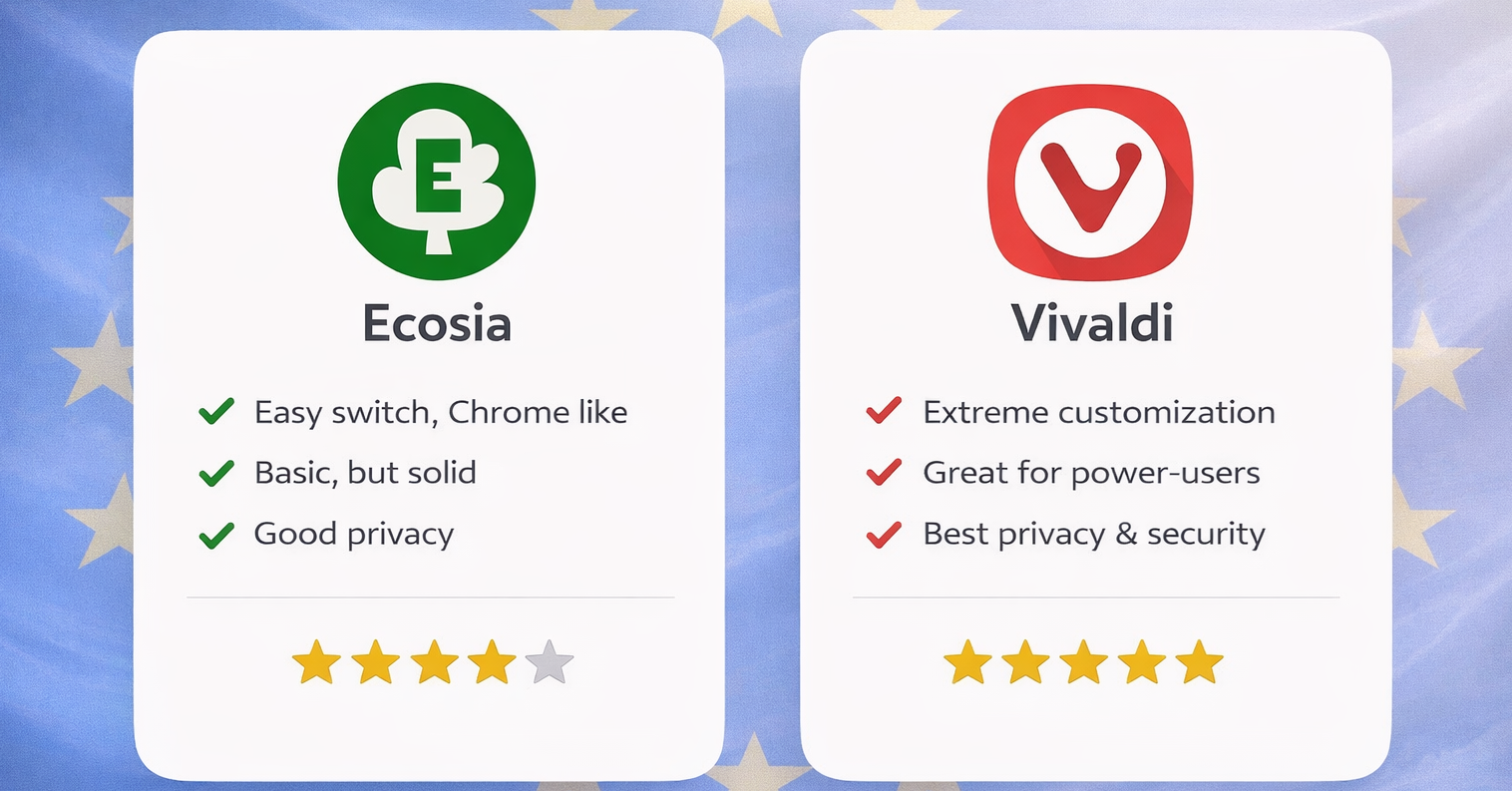
The good news is that there are solid European browsers available. The bad news is that they are all based on the Google Chromium project, which creates a technical dependency. Are you an average user? Ecosia makes it easy to switch with strong security controls and some customization options. Are you a power user? Vivaldi is excels with extensive customization, sync and zero telemetry. Eurotechguide recommendation: Ecosia for most users, but Vivaldi is the best if you’re willing to go through a short learning curve. Surfing the European way: private browsers without Big Tech is certainly possible!
Introduction – why switch?
Like many Europeans, my digital life ran almost entirely on US Big Tech infrastructure. Google and Microsoft powered everything: e-mail, drive, office suites, photos and much more. But as I explored in previous articles (why there is no European Big Tech and why European tech matters), this dependency is risky. Countries are turning inward, Big Tech-political entanglements are growing and digital services become geopolitical leverage. Europe spends over €300 billion yearly on US Big Tech; redirecting just 10% could transform our digital landscape.
To help consumers prioritize where to start, I created a Digital Consumer Services framework prioritizing tier-one essentials: e-mail, drive, search, office and some others. If I plot my own usage, before I started switching, on that framework only Spotify qualifies as European. And although their music service is great, it’s not really a fundamental service. Time to act.
To select viable European alternatives, I applied three criteria:
- Repeatable for average consumers (no advanced technical skills needed). Typically, this means the solution should be part of a wider ecosystem in order to avoid using many separate services, which introduces too much complexity.
- Fully European – owned, jurisdiction and servers/data centers in Europe. Europe is defined as the EU, EU candidate countries plus the UK, Switzerland and Norway.
- Significant scale – €20M+ annual revenue for continuity
In this series of articles, European solutions for tier 1 digital consumer services will be evaluated. In part 1 of this series, European alternatives for e-mail management were evaluated, where both Proton and Infomaniak proved to be very good. In part 2, focusing on the cloud “Drive”, Infomaniak proved to the best all-rounder, while Proton is the strongest for privacy maximalists and Stratos is the recommended option if the service has to be EU based.
Browser
A browser in this article is defined as a “Tool to navigate the internet, balancing privacy and usability”.
Which browsers to include?
The purpose of this article is to determine which European browser an average consumer could start using now. And which ones are not fit (yet). The following digital consumer services meet the filter criteria (European, fit for the average consumer, €20M+ annual revenue):
- Ecosia:Ecosia first of all has a very good search engine, but also offers a Chromium based browser.
- Qwant: similar to Ecosia, Qwant also provides a search engine first and foremost, but offers mobile browser apps as well.
- Vivaldi: Vivaldi is the only one included which provides a browser as main business. Although Vivaldi’s annual revenue is below the €20M threshold (estimated €6–16 million), it has been included because it is already existing since 2016 and is reasonably popular.
For reference, just like in part 2, Google is used to benchmark the European alternatives.
Before diving deeper into those companies and their solutions, it is important to mention that all three browsers are built using Chromium. Chromium is the open‑source browser engine initiated and largely developed by Google. This means that even when the product and company are European, the technical foundation is still tied to a Google‑led codebase.
Disqualified browsers
Some other solutions which were considered, but disqualified:
- Startpage: disqualified due to majority US ownership. Startpage is a Dutch search engine and mobile browser, but disqualifies under the ‘fully European’ criteria because it has a US based majority owner (System1). Although Startpage emphasises that operations and servers are in the EU and that US staff have no access to identifying data, this ownership still creates a theoretical path for the US Cloud Act to be invoked via the parent company. It also means that part of every Euro spent on Startpage ultimately accrues to its US majority owner.
- Opera: disqualified due to Chinese ownership. A popular browser and Opera is based in Norway, but Opera is owned by a Chinese company (Kunlun Tech Co., Ltd.)
How European and how large?
To assess how European a solution really is, it is important to analyze a number of aspects. The most important ones are: who owns the solution, where the headquarters are located, what jurisdiction is applicable, if there are data centers in Europe and which party manages the data centers. If all of these are European, then it is fair to state that the solution is fully European. These aspects are analyzed in the table below:
Ecosia, Qwant and Vivaldi can be considered fully European. Qwant and Ecosia are even fully EU based, whereas Vivaldi is fully Norwegian (definitely European, just not EU).
| Topic |  |  |  |  |
| Owner | European – golden share owned by German Purpose Foundation | European (mix Polish/French/ German) | European (Norwegian) | Alphabet |
| Headquarter location | German | France | Norway | United States |
| Jurisdiction | German | France | Norway | United States |
| European data center(s) | Yes | Yes | Not relevant (no backends) | Yes (but your data may be elsewhere) |
| Party who manages servers | Ecosia | Qwant | Not relevant (no backends) | |
| Revenue/year of the owner | >€35M | Not fully clear. Some claim $19M. Others estimate $50M-100M | Estimated between €6 and €16 million | $385 billion (Alphabet total) |
Browsers
Security
Security and privacy are among the key topics for many consumers. Therefore, it is important to highlight what the differences are between the solutions:

Vivaldi really stands out as the browser where security and privacy come first. Qwant and Ecosia share a very clear second place. The last of the pack, by quite some distance, is Google Chrome. Although that is an excellent browser, which I’ve been using for many years, it is a key enabler for Google to collect as much data as possible from users.
Performance
Performance testing is quite technical and the simple conclusion is that there are barely any differences between the browsers. It is not a factor in deciding which browser to adopt. If you’d like to learn how this conclusion was reached, click on the arrow below.
Methodology and results of the performance tests.
Test devices
The test devices used are:
- Windows: Windows 11 25H2, Ryzen 7800X3D, 64 GB DDR5 RAM, Lexar NM790 2TB SSD
- Android: Samsung S24 256 GB, Android 16, One UI 8.0
- iOS: iPhone 16 Pro 256 GB, iOS 26.1
Methodology
For each Windows browser the following tests have been executed:
- Page load speed: the following sites have been tested using Google Lighthouse:
- google.com
- eurotechguide.com
- bbc.com
- bol.com (note that this URL was excluded for mobile testing since bol.com blocks the webpagetest.org IP address)
This has been repeated 3 times for each browser and the time for Lighthouse Largest Contentful Paint (LCP) and Performance scores have been used as key metrics to determine the page load speed.
On mobile browsers (Android and iOS), the Lighthouse LCP and Performance scores have been collected with webpagetest.org with the same setup (3 runs per measurement per browser per platform).
- Resource efficiency: for the Windows browser the total RAM usage, using incognito windows, has been used to determine resource efficiency. The pages, which were opened simultaneously, were the same as the previous test. This has also been done 3 times and the average has been used.
Results
The table below shows data on the results and a ranking related to that specific test.
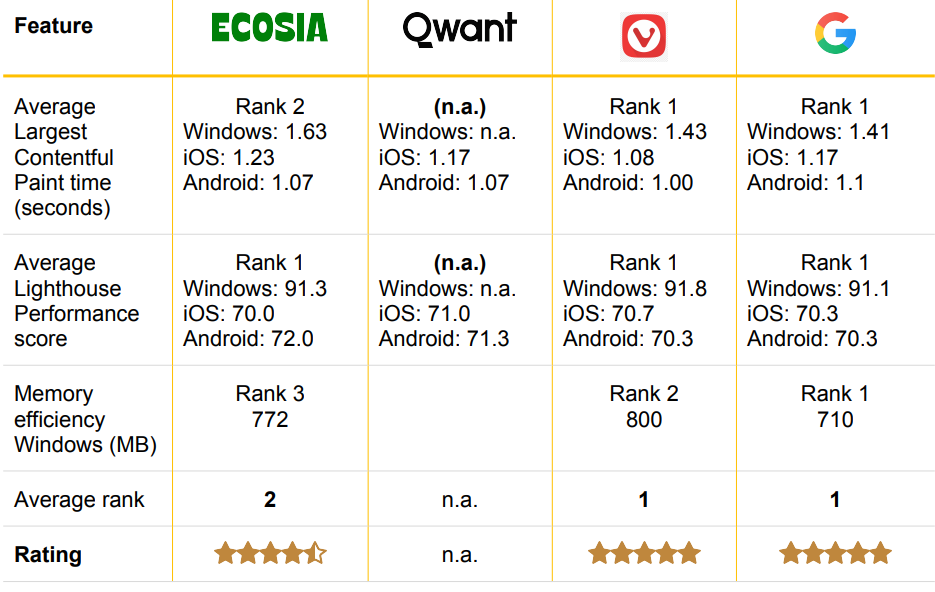
Testing this was quite time consuming, but the conclusion could barely be more straightforward: there is no noticeable difference in performance between the 4 browsers. The only obvious difference is that Qwant doesn’t have a Windows/MacOS/Linux browser, but the performance of the mobile apps is very comparable to the others. This is not strange either, since all browsers are based on the Chromium platform developed by Google. Note though that only Windows, Android and iOS were tested, so MacOS and Linux have not been test separately.
User interfaces and basic functions
The table below provides an overview of the rating of each of the basic functions in the digital consumer services, on a scale of 1-5.
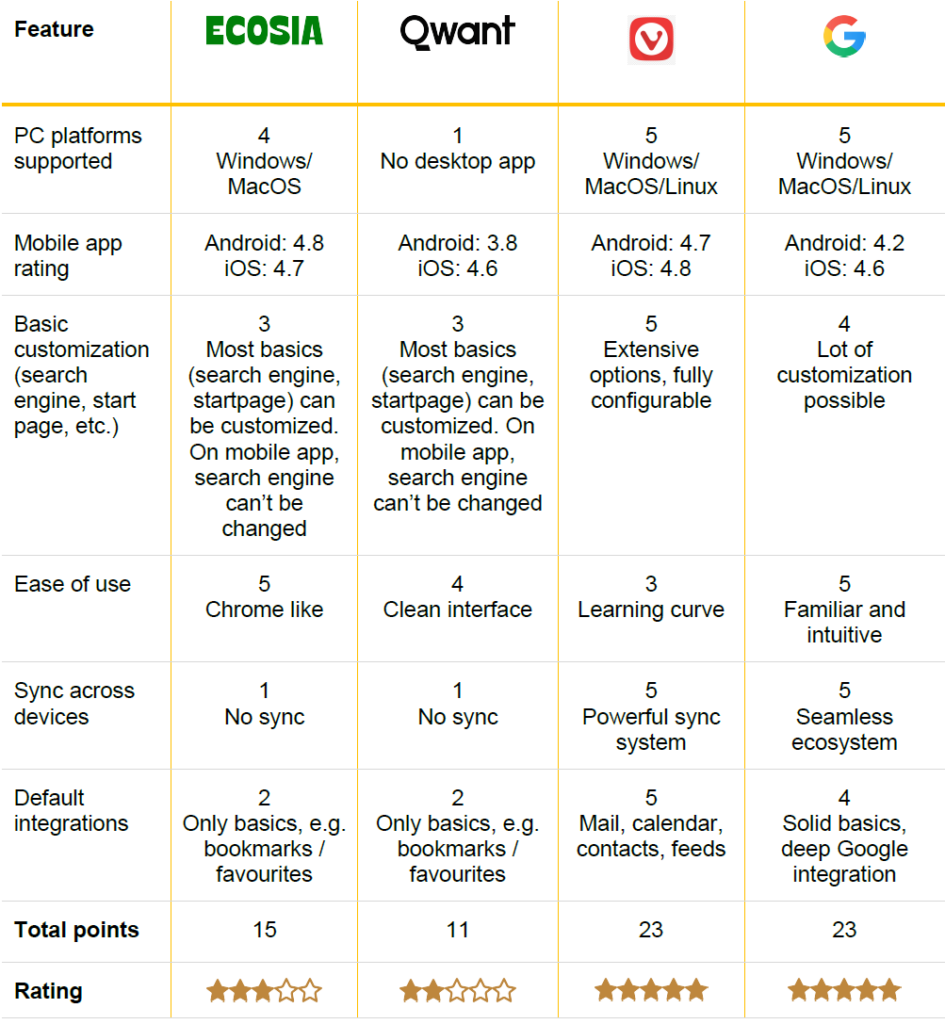
It’s not very surprising that Google scores best when looking at basic functions. It may be surprising that Vivaldi basically scores the same – it’s even better in some areas than Google. The key attention point with Vivaldi is that the learning curve is steeper than with the others. Ecosia also proves to be a solid browser, while Qwant is missing some basics (like a desktop browser) to really qualify as a competitor to Chrome. On downside of the Ecosia mobile apps is that the search engine is locked to Ecosia. The same goes for Qwant, where it is of course locked to the Qwant search engine.
Below you find some screenshots of the Vivaldi and Ecosia desktop apps:
Below you find some screenshots of the Vivaldi and Ecosia iOS browser apps:
Advanced/extra functions
The table below provides an overview of the rating of each of the more advanced functions in the digital consumer service, on a scale of 1-5.

The bottom line
The main business of Qwant and Ecosia is “Search engines”, which will be the focus of the next article. Particularly Ecosia offers a surprisingly competent browser with a very smooth learning curve. Even though Vivaldi is much more feature rich and stronger in every other way, for the average European consumer, Ecosia is probably a better starting point. Vivaldi stands out as the first European browser that can realistically replace Chrome for demanding users. Vivaldi’s rich customization, integrated tools and power‑user features make it the most convincing everyday driver for those who want to move away from Big Tech without sacrificing comfort.
At the same time, its deep reliance on the Chromium code base, just like Ecosia and Qwant, underlines the strategic gap Europe still faces. Vivaldi may be the best European alternative available today, but it is still built on foundations largely controlled from outside Europe and that dependency will remain the next frontier to tackle.
Summary of all results

My recommendation: who should choose what?
🏆 For power users: Vivaldi
Why? Vivaldi matches Chrome on features while offering extreme customization, built-in productivity tools (mail, calendar, RSS), strong sync and robust extensions. Vivaldi also has the best implementation of security of all browsers tested.
Trade-offs:Just one – which is the steeper learning curve. This is the only hesitation I would have to label it the best browser for everybody.
My choice: After going through the short learning curve, I decided to fully adopt Vivaldi on my phones and desktop computers.
👨 For most users: Ecosia
Why? Delivers a familiar Chrome-like experience with strong privacy, ad-blocking, and climate-positive mission (trees planted per search). Simple, accessible and fully European.
Trade-offs: No major, but some smaller ones: no sync between browsers/devices,slightly lower security/privacy compared to Vivaldi (but much better than Google),fewer power-user tools. Also no Linux browser.
Update 24-1-2025: both Qwant and Ecosia mobile apps don’t allow changing the search engine, while the Ecosia desktop app does allow this. This is now reflected in the evaluation.