
This article is part of the “The “Switching to European Tech” series – the good, the bad and the ugly” series. More will follow in the upcoming period!
European search is no longer just a niche or a statement – it works. Ecosia and, to a lesser extent, Qwant deliver solid results, good performance and meaningful privacy advantages. But the reality is more complex: core search infrastructure still depends heavily on Google and Bing, and true independence will take time. This article evaluates today’s European search engines in detail and explores Staan, the emerging European search index, to separate genuine progress from optimistic assumptions.
Introduction – why switch?
Like many Europeans, my digital life ran almost entirely on US Big Tech infrastructure. Google and Microsoft powered everything: e-mail, drive, office suites, photos and much more. But as I explored in previous articles (why there is no European Big Tech and why European tech matters), this dependency is risky. Countries are turning inward, Big Tech-political entanglements are growing and digital services become geopolitical leverage. Particularly the US, the long term major ally of Europe, is alienating itself increasingly from Europe and the future is quite unpredictable under current leadership. Europe spends over €300 billion yearly on US Big Tech; redirecting just 10% could transform our digital landscape.
To help consumers prioritize where to start, I created a Digital Consumer Services framework prioritizing tier-one essentials: e-mail, drive, search, office and some others. If I plot my own usage, before I started switching, on that framework only Spotify qualifies as European. And although their music service is great, it’s not really a fundamental service. Time to act.
To select viable European alternatives, I applied three criteria:
- Repeatable for average consumers (no advanced technical skills needed). Typically, this means that it’s a big benefit if a service is part of a wider ecosystem in order to avoid using many separate services, which introduces too much complexity. Ease of use is the single most important enabler to get consumers to use European products.
- Fully European – owned, jurisdiction and servers/data centers in Europe. Europe is defined as the EU, EU candidate countries plus the UK, Switzerland and Norway.
- Significant scale – €20M+ annual revenue for continuity
Path for average consumer to European alternatives
In this series of articles, all tier 1 digital consumer services will be explored and recommendations will be made for those which are the best fit for average consumers. The purpose is to create a path the average European consumer can follow easily and with the least friction. So far, this path looks like this:
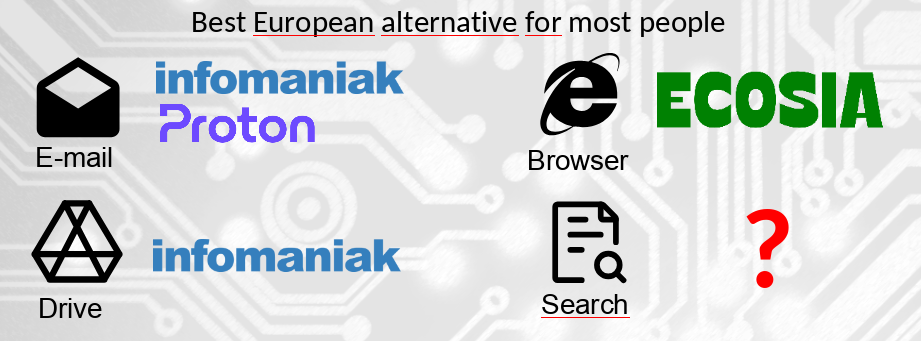
Note that for browsers, Vivaldi is the best European browser, but has quite a learning curve, which is why the Ecosia browser is recommended for most people.
Which European search engines?
In this article, European “Search” digital consumer services will be tested. The following services qualifies meeting the filter criteria (European, fit for the average consumer, €20M+ annual revenue):
- Ecosia
- Qwant
For reference, just like in part 2 and 3, Google is used. Both Qwant and Ecosia also provide browsers, although only the Ecosia one is worth recommending (a lot actually, it’s very good). An important footnote is that in the Qwant and Ecosia mobile browsers, only their own search engine can be used, while in the Ecosia desktop browser (Qwant doesn’t have one) also 4 other search engines can be selected, including Google and Bing.
Before diving deeper into those companies and their solutions, it is important to mention the bad news. Both search engines are at least partially use Google and/or Microsoft Bing search indexes. The good news is that Qwant and Ecosia are teaming up in the European Search Perspective to create a European search index, named Staan. Staan is an abbreviation for the Search Trusted API Access Network. More will be explained about this later in this article.
Therefore, it is currently not possible to decouple fully from US Big Tech in this area, but choosing a European search engine will help these companies grow and mature the European search index further.
Excluded search engines
Some other search engines which were considered, but disqualified:
- Startpage: disqualified due to majority US ownership. Startpage is a mostly Dutch search engine with mobile apps and disqualifies under the ‘fully European’ criteria because it has a US based majority owner (System1). Although Startpage emphasises that operations and servers are in the EU and that US staff have no access to identifying data, this ownership still creates a theoretical path for the US Cloud Act to be invoked via the parent company. It also means that part of every Euro spent on Startpage ultimately accrues to its US majority owner.
- Lilo: disqualified due to too low revenue, estimated at $4.2 million/year.
- MetaGer: disqualified since it’s not a fit for an average consumer and too low annual revenue. While the concept of MetaGer is interesting and the best for privacy, it’s not fit as a Google search replacement for an average consumer. The main reasons are the slow metasearch aggregation and complexity around token management. In addition, it can only be used paid – there is no free option.
- Mojeek: a U.K. search engine with it’s own search index. However, it is disqualified due to too low revenue – estimated at $193k/year.
How European and how large?
To assess how European a solution really is, it is important to analyze a number of aspects. The most important ones are where the headquarters are located, what jurisdiction is applicable, if there are data centers in Europe and which party manages the data centers. If any of these are not European, then it is fair to state that the solution is not fully European. These aspects are analyzed in the table below:
| Topic |  |  |  |
| Owner | European – golden share owned by German Purpose Foundation | European (mix Polish/French/ German) | Alphabet |
| Headquarter location | Germany | France | United States |
| Jurisdiction | Germany | France | United States |
| European data center(s) | Yes | Yes | Yes (but your data may be elsewhere) |
| Party who manages servers | Amazon (AWS) mostly | Qwant | |
| Revenue/year of the owner | >€35M | Not fully clear. Some claim $19MSome estimate $50M-100M | $385 billion (Alphabet total) |
| Sovereignty Index weighted score |
Qwant can be considered fully EU. Ecosia is also almost entirely EU, except for that they run their software mostly on AWS. A migration to a European Cloud provider would be highly desirable.
Previous Qwant ownership controversy (Axel Springer)
Until 2023, Qwant was partially owned by a very controversial shareholder (Axel Springer). A 2022 Foreign Policy analysis described it as having a ‘decades-long record of bending journalistic ethics for right-wing causes’. Axel Springer has drawn criticism for conservative-leaning editorial positions, populist tactics in Bild, and blending journalism with political advocacy – including pro-Israel stances like allowing advertising on its Yad2 platform on houses in illegal West Bank settlements. However, since Axel Springer currently has no link anymore with Qwant, this will of course not be taken into account anymore in the rest of this article.
Search engines
European search index: Staan
Staan (Search Trusted API Access Network) is the cornerstone of a new European search infrastructure developed by Ecosia and Qwant under their joint venture European Search Perspective (EUSP). Launched in 2025, Staan represents a direct challenge to U.S.-dominated search backends (Google and Bing) by building a privacy-first, EU-hosted search index that both search engines can use without relying on Google or Microsoft.
Current status
The planned target for Staan was to serve roughly 30% of Ecosia’s German search traffic is from Staan by late 2025, but no data can be found on the current status. For Qwant, about 50% of the search results in France were targeted to come from Staan round about the same time, but no data can be found to validate if this is the case. However, if this is indeed the case, this is a meaningful start toward replacing Bing and Google for core query coverage, although both engines still fall back to Bing and Google for many queries, especially outside primary languages. The first language, which is being served by Staan is French, followed by German and English in the future. This is a typical European problem – it will take many years for Staan to be able to handle all 27 European languages. However, with French, German and English, a large part of Europe can already be served.
So what’s next for Staan?
Over the next five years (2026–2030), EUSP plans to expand Staan’s footprint beyond French queries, progressively increasing its share of total traffic and enabling AI-enhanced search features and alternative search partners via its open API. A target which has been mentioned is that Staan should handle 5-10% of all European search traffic by 2030.
Ads and monetization will eventually be integrated into the Staan ecosystem through licensed APIs, allowing partners to insert contextual ads while preserving strong privacy defaults – a key differentiator from Google’s personalised ad business. This has huge potential and could play a large role in redirecting money from US Big Tech to Ecosia and Qwant.
Privacy & security
Privacy is a key topic nowadays, particularly in the context of search engines which receive a lot of sensitive information. Therefore, it is important to highlight what the differences are between the solutions:
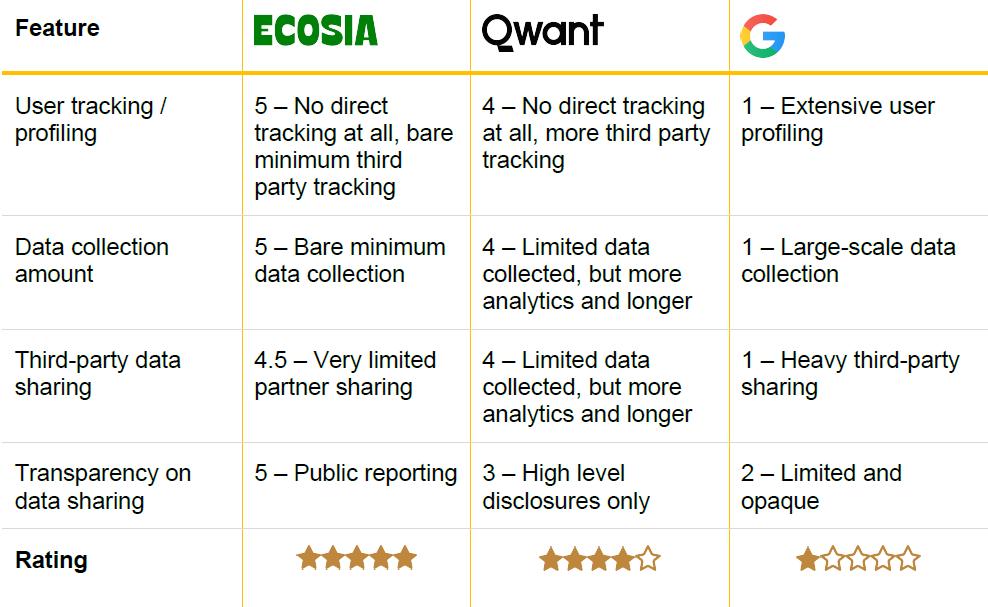
Qwant was expected to be the winner given it’s reputation as privacy-centric search engine. And to be fair, it is quite privacy centric, so this is certainly not a lie. However, going through the privacy policies of both Ecosia and Qwant, Ecosia actually stands out as the most privacy-centric engine. For example, Qwant states that IP adresses are deleted after 6 months, whereas Ecosia anonymises it after 7 days. Less surprisingly, Google is by default quite horrible at privacy, although there are some workarounds possible, e.g. by not logging in, using incognito tabs and VPN connections.
Performance and web search
Methodology
A test has been conducted on January 22 using 11 search queries on these 3 search engines using a Vivaldi browser on Windows 11 in the Netherlands in English language. For all searches, an incognito window has been used, no accounts were logged into and search engine cookies were rejected. This is a controlled, repeatable query set covering everyday, edge-case and AI-assisted searches to objectively compare relevance, quality, bias, and transparency. All tests have been executed 3 times to ensure consistency. These are the searches which have been executed:
- “capital of Slovenia”
- “best noise cancelling headphones 2025”
- “openstreetmap website”
- “EU AI Act explained”
- “how to encrypt a usb drive windows 11”
- “best italian restaurant near me”
- “why do lithium batteries degrade over time”
- “jaguar speed”
- “compare proton vpn and mullvad”
- “is remote work more productive than office work”
- “are right wing views being censored online”
Results
All features are weighted equally, with the exception of “Relevance & quality” which has triple the weight of the others. The table below shows an overview of the relevant features and the rating (1-5) for each search engine provider:
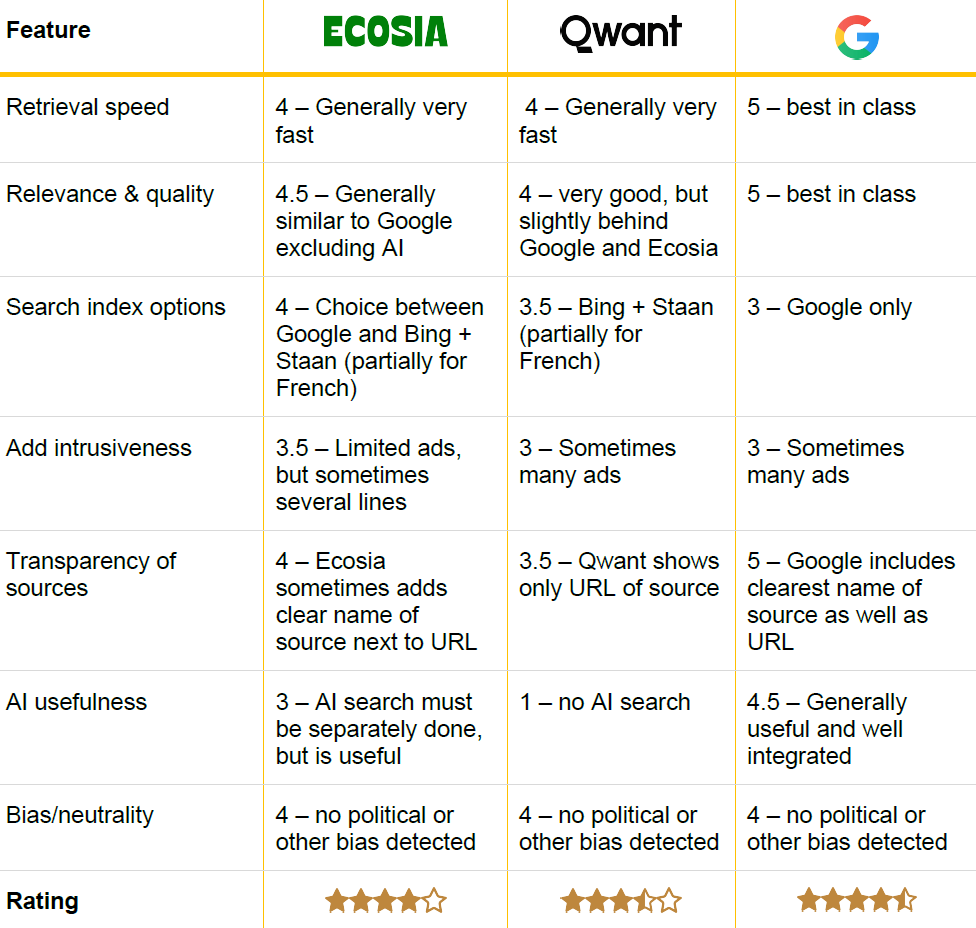
Google leads the pack because of it’s extreme speed and the general usefulness of it’s integrated AI results. Ecosia beats Qwant, because it shows adds less intrusively, regularly shows useful information widgets and has a fairly useful AI search capability. Qwant is still a very usable search engine, but lags a bit behind.
Ecosia by default uses the Google or Bing search index, but the user can choose to use either one. This allows a user to alternate between the two if you prefer to minimize the footprint on either. Over time, for both Qwant and Ecosia, it is expected that Staan will become the main search engine for all languages, but that is expected to take years.
Other functions
The table below provides an overview of the rating of some of the other relevant search engine functions, on a scale of 1-5.
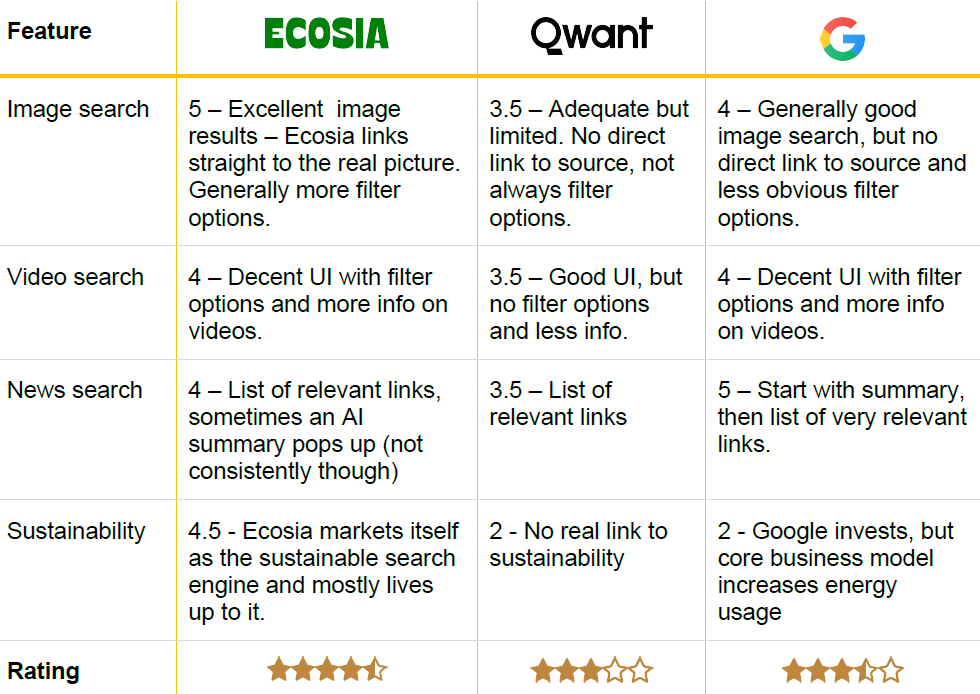
Ecosia is the best search engine for searching images, primarily because it directly links from the search engine to the image itself. This makes it easy to copy or save the image without plowing through yet another website, managing cookies, finding download links, etc. For consumers this is great, but as a content creator this is a drawback. However, in this review, we are looking at it from consumer usability point of view. For the rest the differences are smaller, but Qwant is consistently trails a bit behind Google and Ecosia.
For those with a heart for our planet, Ecosia also has an additional benefit in that they have verifiably planted many trees (current status 246 million) and have dedicated over 98 million Euro to climate action. However, it is of course still the case that a lot of Ecosia’s revenue (exact details not available), flows to Google and Bing, which have much less focus on sustainability. Still, this is highly commendable and a pro for Ecosia.
The bottom line
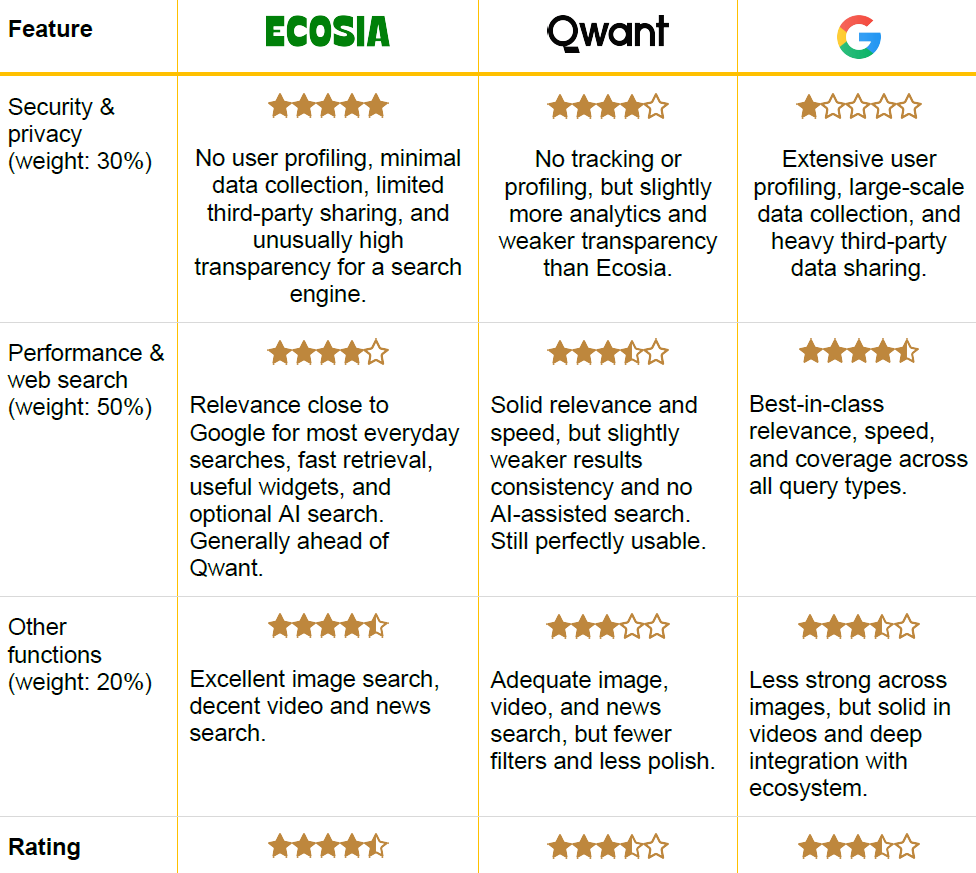
From a European sovereignty perspective, search is one of the hardest services to replace, but also one of the most impactful. Among the viable European options, Ecosia emerges fairly clearly as the strongest overall choice for most users today. It consistently delivers high-quality results, excellent image search, relatively unobtrusive advertising, meaningful sustainability impact and somewhat unexpectedly, the strongest privacy posture of the European contenders. For an average consumer looking to switch with minimal friction, Ecosia is the most complete and convincing alternative.
Qwant, while trailing slightly in relevance, features, and polish, remains a perfectly usable and credible European search engine. Its performance is good, its privacy claims are largely substantiated, and for users prioritizing a French-rooted ecosystem, it is still a valid option. And it is as sovereign as it can be (also the infra is European), even though both Qwant and Ecosia are of course tied to Big Tech due to the search engine. Other than that, the gap with Ecosia is real, but not dramatic.
The uncomfortable truth is that full independence does not yet exist. Both Ecosia and Qwant still depend heavily on Google and Microsoft Bing for large parts of their search coverage. Staan changes this trajectory, but it is still small. Today it handles only a fraction of queries; tomorrow, if adoption and investment continue, it could become the backbone of European search. Choosing Ecosia now will help Ecosia grow, makes at least a small contribution to the environment and it is quite frictionless, coming from Google or Microsoft.
Summary of all results
The table below provides a summary of the ratings in each of the sections:
My recommendation: who should choose what?
🏆 For most users: Ecosia
Why? Ecosia is currently the best all-round European search engine. It delivers strong relevance, excellent image search, acceptable AI assistance, low ad intrusiveness, and the strongest privacy posture of the European options. At the same time, some contribution to funding climate improvements is also done by Ecosia. Switching from Google is relatively painless, making it the lowest-friction choice for average consumers.
Trade-offs: Still partially dependent on Google and Bing for search results. And most Ecosia infrastructure is running on Amazon AWS. Furthermore, the AI features are less integrated than Google’s.
🛡️ For digital sovereignty purists: Qwant
Why? Qwant is the most sovereign European search engine available today: developed, operated, and governed in Europe, with strong institutional alignment around independence, public interest, and strategic autonomy. If your priority is reducing structural reliance on non-European tech stacks rather than chasing feature parity, Qwant is the clearest choice.
Trade-offs: As outlined in your article, Qwant still trails on relevance consistency, depth of ancillary services, and overall ecosystem maturity. It works well for general use, but power users and edge cases will hit limitations faster than with Google—or even Ecosia.
.
Change log:
– 27-2-2026: Added the Sovereignty Index weighted scores, including links to the relevant score cards to each of the solutions in section “How European and how large”