
This article is part of the “The “Switching to European Tech” series – the good, the bad and the ugly” series. More will follow in the upcoming weeks!
Both Proton Mail and Infomaniak Mail are strong European e-mail options which make switching to European e-mail alternatives easy. Proton is best for maximum privacy and security, while Infomaniak suits most users and offers a stronger integrated office suite. For basic e-mail, both free plans are sufficient, though extra storage may be needed for drive features. I personally switched to Proton Mail.
Introduction – why switch?
Like many Europeans, my digital life ran almost entirely on US Big Tech infrastructure. Google and Microsoft, in particular, powered almost everything: e-mail, drive, office suite, photos and many other digital services. In a previous article, I investigated why there is no European Big Tech, suggesting this is due to fragmented markets, risk-averse finance and complex regulation.
In another, I wrote about why it is important to have European tech. There are two main reasons: countries are becoming more inward-focused and the entanglement of Big Tech and politics is increasing. Access to digital consumer services is becoming a geopolitical bargaining chip and Europe is vulnerable. It is obvious that the EU and national governments have an important role to play in nurturing the growth of European solutions. However, as European consumers we should start using European solutions, so they can grow. Europeans spend over €300 billion per year on US Big Tech. Redirecting 10%, or even a lower share, of that amount towards European digital consumer services, would be an enormous boost.
To help European consumers decide which services to adopt first, I developed a Digital Consumer Services framework. The purpose of this framework is to prioritize those digital consumer services most important to an average European consumer. Three tiers are distinguished, with tier one covering the most important fundamental services. To move from analysis to action, I have started adopting European solutions, focusing first on tier one services, like e-mail, drive, search and an office suite. Since usually a digital service is in an ecosystem, some tier two services are also in scope as collateral benefit. My goal is to create a path that the average European consumer could follow without significant compromises. By the end of this series of articles you will know, based on my experiences, what works well, what shows promise (but isn’t there yet) and what does not qualify as a viable alternative.
What Big Tech solutions have I been using?
I’ve been mainly relying on Google and Microsoft, but also other Big Tech, like Apple, Amazon and Meta have been powering my digital life. I plotted my dominating Big Tech solutions on the Digital Consumer Services Framework in Figure 1. In some cases, solutions from smaller companies have been used (e.g. LastPass and Private Internet Access). Or in case of “Finance”, many solutions are used (iDeal, Mastercard, Visa, Paypal) and there is no real dominant party.
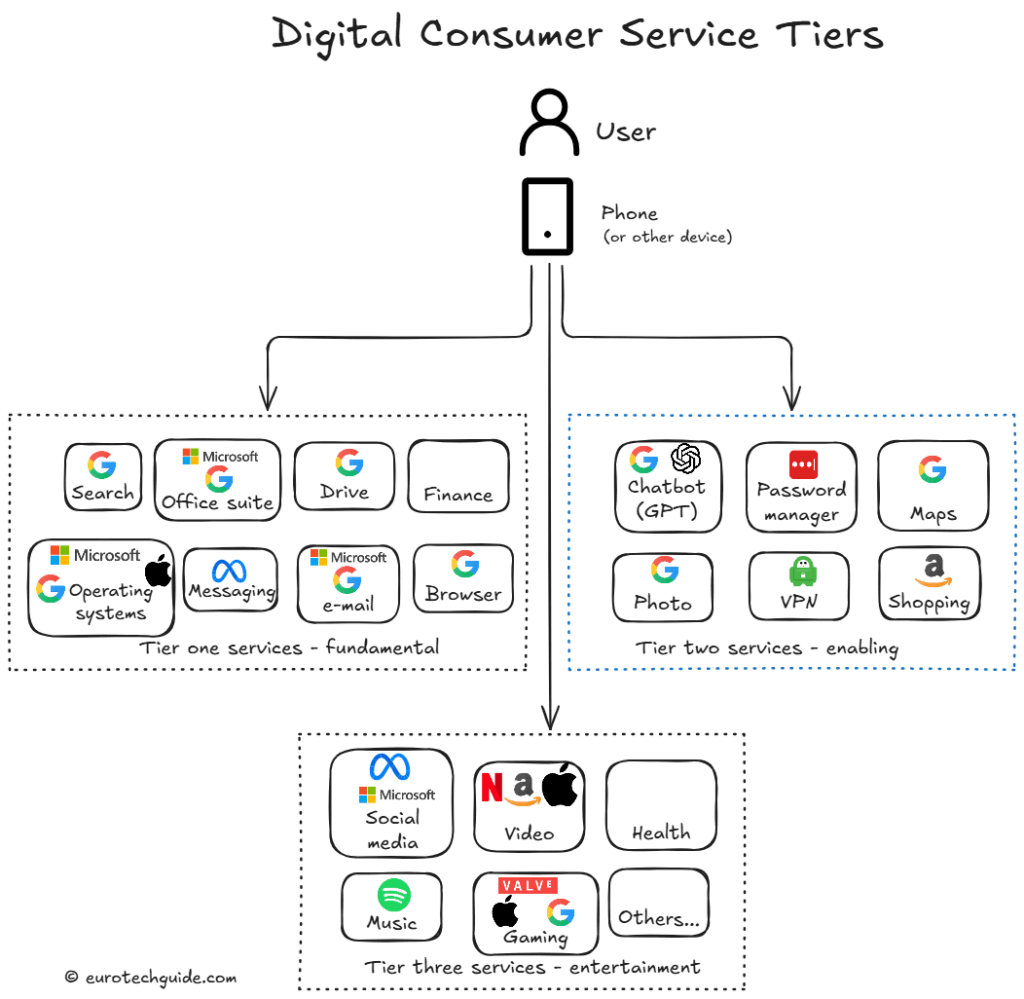
Figure 1: my digital consumer services
So where are the European solutions? As a matter of fact, there is just one: Spotify. Which may be qualified as the only real European Big Tech for a digital consumer service (music in this case). For the rest, no European solution in sight.
Which European solutions qualify?
My selection criteria are:
- It must be repeatable for an average consumer. In case a solution requires deeper tech knowledge, this will be clearly indicated.
- The solutions must be fully European:
- The company must be European owned
- The solution must fall under European jurisdiction
- The servers and data centre infrastructure must be on European soil and managed by a European company (e.g. no AWS or Azure)
Europe is defined here as the EU, EU candidate countries plus the UK, Switzerland and Norway.
- The European companies must have a significant size: more than €20 million revenue per year is considered the minimum. The main reason is that a sizeable company has a larger chance of continuity – bankruptcy or a full pivot are less likely to happen.
In the article on the Digital Consumer Services framework, I already made a shortlist of European solutions and in the next sections, my experiences with them are shared. More extensive reviews on some of those solutions will follow. Note that solutions, which are part of a bigger ecosystem, are preferred. Main reason for this is that replacing Google and Microsoft with 12 small solutions is not a realistic proposal for an average consumer. A few bigger ecosystems are much more likely to be interesting.
In this article, the first and arguably most important digital consumer service will be treated: e-mail. This is an area where there is good news. There are quite a number of interesting European e-mail solutions. I have tested two of them and both are also a part of a bigger ecosystem. These are Proton Mail and Infomaniak Mail – both are created by a fairly sizeable, stable company (€70 – €120 million revenue/year) and both are fully Swiss. At the end of each short review, a qualification of “good”, “bad” or “ugly” will be given to the digital service.
Proton Mail
Proton Mail is a Swiss digital service with a strong focus on privacy and security. Proton’s apps and services are generally affordable, intuitive and privacy respecting. They also include quite a strong ecosystem, including e-mail, calendar, drive, VPN and a password manager. A unique selling point is that it offers market leading end-2-end encryption of e-mails on a standard that is is not possible with Google or Microsoft by regular consumers. Proton Mail is really excellent and an easy replacement for Big Tech regarding functionality and performance, with the added bonus of security and proper privacy. Proton Drive and some of the others will be touched upon in later sections. I have decided to purchase Proton Unlimited and adopt it as my primary e-mail management system.
All my e-mails and contacts have also been migrated from Microsoft to Proton and this was very easy using their migration tools. The biggest challenge has been to update e-mail addresses in all websites where they are used as login, but even that isn’t really needed with just an auto-forwarding rule in Microsoft.
Conclusion: excellent. Highly recommended for those who value privacy and security the most. The ecosystem of Proton is also strong with as specials VPN and a solid password manager. I decided to move to Proton as my primary e-mail solution.
Infomaniak Mail
Infomaniak is, just like Proton, a Swiss digital service that combines privacy with a user-friendly design. From a security point of view, Infomaniak is good, but Proton has an even better reputation. This has been one of my main reason for selecting Proton Mail instead of Infomaniak Mail. Just like Proton, Infomaniak Mail is part of a bigger ecosystem, which includes a drive, calendar, an AI chatbot, a video conferencing tool and several others. Infomaniak does offer a Calendar, but there is specific Infomaniak mobile app yet. It is accessible through the web interface and can be loaded into any standard calendar app, like Google Calendar. The e-mail solution is easy to use, has all the basic functionality, a good integration with their drive solution and is generally on par with Big Tech alternatives.
The free variant of Infomaniak has no significant limitations for average users. I also purchased a subscription for Infomaniak kSuite (which includes mail) primarily for the kDrive – this will be touched upon in the next article in this series.
Although I haven’t tested this myself, Infomaniak (just like Proton) has developed a migration tool making it easy to import e-mail and contacts from the major Big Tech e-mail providers.
Conclusion: excellent. Highly recommended for everybody except those that must have the very best security available or prefer the ecosystem of Proton. Note that Infomaniak still has very high security standards and a very strong ecosystem (e.g. drive, office suite). Even though I decided to move to Proton Mail, Infomaniak Mail is a worthy European competitor.
Proton Mail and Infomaniak Mail screenshots:
Conclusion
My goal is to create a path that the average European consumer could follow without significant compromises. In the first part of this series, both Proton Mail as well as Infomaniak Mail have shown that they are definitely on that path.
Both are excellent e-mail services. Proton is a better fit for those who value privacy and security the highest. Infomaniak is a good fit with virtually everybody else, while still offering very high standards of privacy and security . Also note that both have different ecosystems. Proton has a strong “Password Manager”, “VPN” and decent drive digital service, while Infomaniak has a strong “Drive” and “Office suite”. Purely for e-mail, the free plan of both is sufficient for the average consumer. Note that for some other capabilities, like “Drive” more storage will be needed. I have personally decided to adopt Proton Mail as my primary e-mail provider and, after about a week, there are no regrets at all. A more detailed review of Proton Mail and Infomaniak Mail will follow after the “Switching to European Tech” series has been finished.
|
Infomaniak Mail Free plan |
Proton Mail Free plan |
| Recommended for: everybody else | Recommended for: those who prioritize privacy and security the most |
| Strong eco-system with very good Drive and office suite | Very strong eco-system with solid Drive, VPN, password manager and photo capability |
| Onboarding process can be a bit confusing | Onboarding process very simple and smooth |
| Privacy and security: very good, better than Google/Microsoft | Privacy & security: best in class |
| Mail and contact migration is easy | Mail and contact migration is easy |
| Contact and calendar syncing is automated | Contact and calendar syncing is not automated |
| Price plans are affordable with lots of storage | Price plans are fairly expensive for lots of storage, but free plan is sufficient for mail. |
Part two of the “Switching to European Tech” series will cover the “Drive” and “Office suite” digital consumer services, where both Infomaniak and Proton are contesting each other again. Who will win this time?





Leave a Reply